
Texas Homeschool Fine Arts Credit
with Free Online Music
How Texas homeschool families can earn fine arts credit through free online music lessons — credit hour calculations, transcript documentation, TEFA funding, and how to use Practicing Musician for every instrument.
Texas homeschool families have more freedom than parents in almost any other state — including the freedom to design their own fine arts curriculum. This guide explains exactly how to earn a legitimate fine arts credit through music, how to document it properly, and how to get started for free today.
Texas homeschool parents award their own credits. Fine arts credit is not legally required — but most college-bound students include 1 credit to stay competitive. Music instruction counts. Log 120–150 hours of lessons and practice across the school year, document it in your activity log, and put it on your transcript. Start with Practicing Musician's free platform — 3,500+ structured lessons across 15 instruments.
New to Texas homeschooling? Start with our complete Texas Homeschool Guide 2025–26.
Is fine arts credit required in Texas?
No. Texas does not require homeschool students to earn fine arts credit. The only legally required subjects for Texas homeschoolers are reading, spelling, grammar, mathematics, and good citizenship — as established by Leeper v. Arlington ISD (1994) and Texas Education Code §25.086(a)(1).
Fine arts is a requirement for graduation at Texas public high schools — but homeschools operate as private schools in Texas and are not bound by the same graduation requirements. You set your own graduation standards.
No state agency can tell a Texas homeschool family what courses to require for graduation. You are the school administrator. Fine arts credit is your choice — and for most college-bound students, it's a smart one.
Why most Texas families include it anyway
Even though fine arts isn't required, most Texas homeschool families include it for two practical reasons:
1. College admissions expectations. Texas public universities and most private universities expect transcripts that resemble the TEA's 26-credit Foundation High School Program — which includes 1 fine arts credit. A transcript missing fine arts can raise questions with admissions offices, even if it's technically acceptable.
2. It's the easiest credit to earn. Music instruction is one of the most naturally documented subjects in any homeschool. If your child takes lessons, practices an instrument, studies music theory, or participates in an ensemble — they are already doing the work. All that's needed is to track the hours and document it properly.
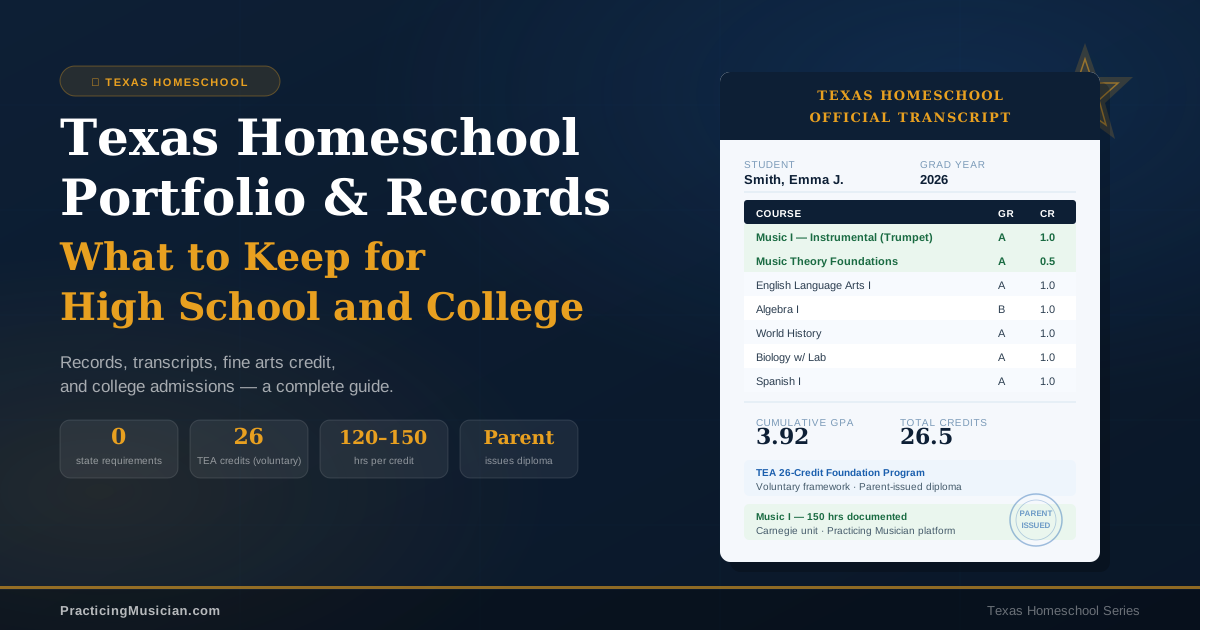
Most college-bound Texas homeschool families build their transcripts around the TEA's Foundation High School Program as a voluntary guide. It includes: 4 ELA, 4 math, 4 science, 4 social studies, 2 foreign language, 1 PE, 1 fine arts, 0.5 health, 0.5 speech, and 5 electives = 26 credits. Following this structure makes the transcript immediately readable to Texas college admissions offices.
How many hours = 1 fine arts credit
Texas homeschool parents set their own credit standards, but the widely accepted benchmark — used by most Texas families and recognized by college admissions offices — is the Carnegie unit standard:
1 credit = 120–150 hours
This includes all music-related time: lesson instruction, home practice, music theory study, ensemble participation, performances, and rehearsals. Here's how a typical year breaks down:
Sample Annual Hour Calculation — Music I (1 Credit)
At just 4 hours per week of combined lesson and practice time — very achievable for most students — your child exceeds the 120-hour minimum comfortably by year end. Many families earn a full credit with even less structured time when ensemble and performance hours are included.
If your student is just starting out or you want to ease into music, a 0.5 credit (60–75 hours) is also perfectly valid on a Texas homeschool transcript. List it as "Music I" or "Music Appreciation" for 0.5 credits. This is especially useful for younger high schoolers in 9th or 10th grade who are building toward a full credit over two years.
What counts toward fine arts credit
Texas gives parents full discretion. Any of the following count toward fine arts credit when hours are logged:
- Instrument lessons — private lessons, online platform instruction, co-op classes
- Home practice — daily instrument practice with a log
- Music theory — theory workbooks, online theory courses, ear training
- Ensemble participation — homeschool band or orchestra, church worship team, community youth orchestra
- Performances and recitals — concerts, competitions, worship services
- Music history and appreciation — listening journals, composer studies, concert attendance
- Music composition — songwriting, arranging, digital music production
- Music technology — recording, audio production, music software
Give the course a clear, specific name on the transcript rather than just "Fine Arts." Examples: Music I, Instrumental Music, Music Theory, Band, Orchestra, Guitar I, Piano I, Music Appreciation, Music Composition. Specific course names look more professional to college admissions offices and make the credit's content immediately clear.
Using Practicing Musician for fine arts credit
Practicing Musician is built exactly the way Texas homeschool families need: sequential, structured, self-paced, and fully documented. Here's why it works so well for fine arts credit:
Sequential lesson structure — built-in progression
Every instrument on Practicing Musician follows a structured curriculum from fundamentals through advanced technique. The sequential progression is exactly what college admissions offices expect to see when they review a music course description — not random YouTube videos, but a coherent, progressive course of study.
Lesson completion tracking — ready-made documentation
The Practicing Musician dashboard tracks every completed lesson. Screenshot the completion screen after each session or weekly — these screenshots serve as your work sample documentation. They show lesson number, title, and completion status, giving you timestamped evidence of sequential progress throughout the year.
15 instruments — every student is covered
Whether your student plays trumpet, clarinet, flute, saxophone, trombone, tuba, French horn, oboe, baritone/euphonium, percussion, violin, viola, cello, or upright bass — Practicing Musician has a structured curriculum for them. One platform, 15 instruments, complete fine arts documentation.
Private lessons — TEFA-eligible, one-on-one instruction
When your student is ready for personalized feedback, Practicing Musician private lessons ($90/month, 4 sessions) add expert-guided instruction built around up-to-date learning research. Teachers assign groups of short video tutorials and exercises through the LMS, students practice independently between sessions, then meet for an efficient 10-minute feedback session where the teacher reviews progress and assigns next steps. This cycle repeats — and all of it qualifies as TEFA-eligible private tutoring. Both the independent practice time and the live feedback sessions count toward your fine arts credit hours.
Sample weekly music schedule
Here is a realistic weekly schedule for earning a full fine arts credit in one school year:
Monday: Practicing Musician lesson — 30 min instruction + 30 min practice = 1 hr
Tuesday: Home practice — 30 min
Wednesday: Practicing Musician lesson — 30 min instruction + 30 min practice = 1 hr
Thursday: Music theory workbook — 30 min
Friday: Home practice + weekly review — 30 min
Weekly total: ~3.5–4 hours · Annual total: ~126–144 hours ✓
Sample activity log entries
Your activity log is the core documentation for fine arts credit. Each entry should include the date, what was done, how long, and the platform or materials used. Here are real-world examples:
How to put it on your transcript
Texas homeschool parents issue their own transcripts. Here's how music fine arts credit looks on a properly formatted transcript:
Include a course description page alongside your transcript. For music fine arts, a one-paragraph description works well:
"Music I — Instrumental (Trumpet): A one-year course in instrumental music focusing on the fundamentals of trumpet performance. Instruction delivered through Practicing Musician's structured online platform (3,500+ video lessons) with weekly private instruction sessions. Course content included: tone production, scales and arpeggios, sight-reading fundamentals, music theory (Alfred's Essentials of Music Theory, Units 1–5), and solo performance preparation. Approximately 150 hours of instruction and supervised practice. Student demonstrated progression from beginner to intermediate level across 36 weeks."
Using TEFA funds for music instruction
If your family participates in the Texas Education Freedom Accounts (TEFA) program, music instruction is an eligible expense:
- Private music tutoring — qualifies under the TEFA tutoring expense category. Practicing Musician's private lessons ($90/month, 4 sessions) use a research-based model: teachers assign video tutorials and exercises through the LMS, students practice independently, then meet for a 10-minute feedback session. All purchases must go through the Odyssey platform.
- Online music programs — structured online music platforms qualify under approved online education programs. Single-student subscriptions are eligible.
- Music theory materials — workbooks and instructional materials qualify as curriculum and instructional materials with no annual spending cap on books.
- Instrument purchases — musical instruments may qualify under instructional materials. Confirm with your SFO before purchasing as pre-authorization may be required.
The 2026–27 TEFA application window ran February 4 – March 31, 2026. If you missed it, sign up for the 2027–28 interest list at educationfreedom.texas.gov. Homeschool families who do not participate in TEFA can still use Practicing Musician's free platform at no cost — no TEFA needed for free lessons.
Start your Texas fine arts credit today — free
3,500+ structured video lessons across 15 instruments. Sequential curriculum, lesson tracking, and portfolio-ready documentation — all free for Texas homeschool families.
Get Started Free → Private LessonsFree forever · 15 instruments · K–adult · TEFA-eligible private lessons · No credit card required
FAQ — questions Texas families ask most
Is fine arts credit required for Texas homeschoolers?▼
No. Texas only requires five subjects: reading, spelling, grammar, mathematics, and good citizenship. Fine arts is not mandated by law for homeschool families. However, most college-bound Texas homeschoolers include 1 fine arts credit on their transcript to align with the TEA's 26-credit Foundation High School Program, which is what Texas university admissions offices expect to see.
How many hours does a fine arts credit require?▼
Texas homeschool parents set their own credit standards. The widely accepted Carnegie unit guideline is 120–150 hours per credit — including lessons, practice, theory study, ensemble participation, and performances. At 4 hours per week across a 36-week school year, your student accumulates approximately 144 hours — a solid full credit by any standard.
Can online music lessons count for fine arts credit?▼
Yes. Texas homeschool parents have complete freedom to determine what counts for credit. Structured online music instruction — like Practicing Musician's platform — counts fully toward fine arts credit when combined with regular practice time. Log your sessions, track your hours, save screenshots of completed lessons, and document progress in your activity log.
How do I document fine arts credit for a transcript?▼
Keep an activity log with dated entries showing hours of instruction and practice. Save screenshots of completed online lessons as work samples. Write a one-paragraph course description. On the transcript, list the course name (e.g. Music I — Instrumental), a letter grade you assign, and credit amount (0.5 or 1.0). Keep your supporting documentation in your records file in case a college requests it during admissions.
Can TEFA funds pay for music lessons?▼
Yes. TEFA approved expenses include private tutoring and online education programs, which covers music instruction from a qualified private tutor or approved online platform. Practicing Musician's private lesson option ($90/month, 4 sessions) qualifies as private tutoring — teachers assign tutorials and exercises through the LMS, students practice independently, then meet for 10-minute feedback sessions. All purchases must go through the Odyssey platform. Note: the 2026–27 TEFA application window has closed. Sign up for the 2027–28 interest list at educationfreedom.texas.gov.
What grade do I assign for music on the transcript?▼
You assign the grade as the parent-administrator of your homeschool. Most families use a standard letter grade (A, B, C) based on their own assessment of effort, progress, and mastery. For music, consider: regular practice habits, lesson completion rate, demonstrable improvement across the year, and any performance or assessment activities. An honest A for consistent, engaged music study throughout the year is perfectly appropriate.
Does the instrument matter for fine arts credit?▼
No. Any instrument qualifies for fine arts credit on a Texas homeschool transcript. Practicing Musician covers all 15 instruments: Band — Alto Saxophone, Baritone/Euphonium, Clarinet, Flute, French Horn, Oboe, Percussion, Tenor Saxophone, Trombone, Trumpet, and Tuba; Orchestra — Cello, Upright Bass, Viola, and Violin. The key is documentation — log your hours, save your lesson completion screenshots, and keep your activity log current regardless of which instrument your student plays.
Texas Homeschool Guide 2025–26 — Complete guide to TX requirements, TEFA funding, associations, and co-ops
Texas Homeschool Portfolio Guide — How to keep records and build a college-ready transcript
How to Use the Texas TEFA Scholarship — Approved expenses, the Odyssey platform, and music tutoring
Key resources
- Texas Homeschool Guide 2025–26 — Complete guide to TX laws, TEFA, associations, and co-ops
- Get Started Free — PracticingMusician.com — 3,500+ free lessons, 15 instruments, K–adult
- Private Lessons — PracticingMusician.com — $90/month, 4 live sessions, TEFA-eligible
- THSC — Texas Homeschool Requirements — Legal guidance from Texas's largest homeschool organization
- TEFA Official Site — Texas Education Freedom Accounts program
- TEA Foundation High School Program — The 26-credit guide most TX families follow
- HSLDA Texas — Legal guidance and transcript resources


Leave A Comment
You must be logged in to post a comment.