
Whose Stories Are Missing?
Why We Partnered with Boulanger Initiative
When we set out to teach American history through music, we had to ask a hard question: whose music were we going to include? The answer led us to one of the most important partnerships in the America's Soundtrack project.
Here's a question worth sitting with: when we teach American history through music, whose music are we teaching?
Three percent. Centuries of composition by women and gender-marginalized musicians, reduced to a footnote in the concert hall — and repeated, year after year, in classrooms across the country.
That statistic has been on our minds as we build America's Soundtrack, our free 225-lesson course teaching American history through the lens of music. We knew from day one that if we were going to tell America's musical story honestly, we couldn't repeat the same erasure that textbooks and concert halls have been practicing for generations.
Which is why we're thrilled to welcome Boulanger Initiative to our Steering Committee for the creation of the course.
Who They Are
Boulanger Initiative
A 501(c)(3) nonprofit that advocates for women and gender-marginalized composers through performance, education, research, consulting, and commissions. Named after Nadia and Lili Boulanger — two sisters who broke barrier after barrier in early 20th-century classical music.
boulangerinitiative.org →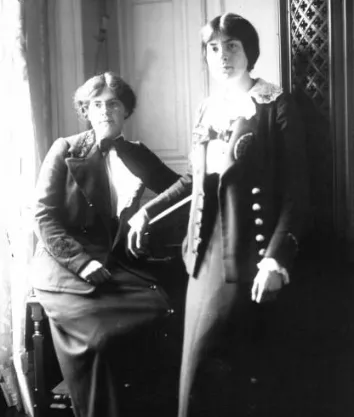
Lili became the first woman to win the Grand Prix de Rome in 1913. Nadia became the first woman to conduct the New York Philharmonic. Their legacy of refusing to accept the status quo runs through everything BI does today.
BI maintains a database of over 17,500 works by more than 1,700 women and gender-marginalized composers — complete with scores, recordings, biographical details, and publisher information. They've done the archival digging that makes real inclusion possible, not just the gesture toward it.
BI operates under a 1:1 rule: every time they promote a white composer, they also promote at least one composer of color. Their Inclusion Advisory Council works from anti-oppression models addressing race, ability, class, and gender together. Their Beyond the Box curriculum was named specifically to push back against relegating women composers to single-paragraph inserts in standard textbooks. Their stated vision? To become obsolete — because that would mean their advocacy is no longer needed.
Why the Structure of This Partnership Matters
A lot of "inclusive" educational content treats diversity as something you bolt on at the end. One lesson about a woman composer. A sidebar about a Black musician. Box checked.
We wanted something different. The people joining the Steering Committee are:
Dr. Laura Colgate
Co-Founder & Artistic/Executive Director, Boulanger InitiativeBrings deep research expertise and a decades-long commitment to intersectional inclusivity in music education and performance.
Dr. Caiti Beth McKinney
Research Manager, Boulanger InitiativeSpecializes in surfacing the composers and musical traditions that most curricula simply ignore — and making that research usable for teachers.
Dr. Colgate and Dr. McKinney are now part of the Steering Committee that will shape the content of America's Soundtrack from the start. Their deep research expertise and commitment to intersectional inclusivity will directly influence what thousands of students learn about American music history when the course launches — not added in a final review, not as a sensitivity read, but as part of the committee deciding what the course actually is.
That intersectional lens is exactly what a course on American history through music needs, because American music history is inseparable from the histories of race, immigration, protest, and identity in this country. You cannot tell that story truthfully with only part of the voices.
Why This Matters for Students
Representation in educational content isn't decoration. It determines which stories students believe are worth knowing. A student who never encounters women composers in a history course absorbs a lesson we never intended to teach: that women didn't contribute.
BI's involvement helps us correct that — not as an afterthought, but from the ground up.
At Practicing Musician, we've spent eight years building a free music education platform now used by over 2,800 teachers in more than 90 countries. Our 3,500+ video tutorials cover 15 instruments and are aligned with National Core Arts Standards. We've always believed that access to quality music education shouldn't depend on your zip code or your family's income. America's Soundtrack extends that belief into music history — created for the nation's 250th anniversary and designed to reach elementary through high school classrooms nationwide.
BI brings something we couldn't build on our own: decades of specialized research into composers and musical traditions that most curricula simply ignore. That knowledge will make America's Soundtrack more complete — and more honest — than any course we could have created alone.
We're building this course because we believe music is one of the most powerful ways to understand where we've been as a country. But only if we tell the whole story.
If your organization is working to expand access to music education or to diversify whose voices are heard in classrooms, we'd love to talk.
Reach out to Dr. Rory Creigh, Vice President of Education, at [email protected].
Explore free music education at PracticingMusician.com
3,500+ free video lessons across 15 instruments, aligned with National Core Arts Standards — used by 2,800+ teachers in 90+ countries.
Get Started Free →Free forever for teachers, parents, and learners. No credit card required.
Share This Story, Choose Your Platform!
About the Author: Practicing Musician

Related Posts

Follow us to get regular updates about music education and Practicing Musician.
© Copyright 2012 - 2026 | Practicing Musician, S.P.C. - All Rights Reserved.
Leave A Comment
You must be logged in to post a comment.