
Florida Homeschool Portfolio —
What the Law Actually Requires
The complete guide to Florida homeschool portfolio requirements: what the statute says, what to keep, how to organize it, what evaluators actually look for, and sample log entries for every age and subject.
The Florida homeschool portfolio is the thing that causes the most anxiety for new homeschool families. Parents spend hours worrying about whether they're doing it "right" — only to discover that Florida's requirements are actually quite simple, and the parent has enormous freedom in how they meet them.
This guide cuts through the confusion. We cover exactly what the law says in plain English, what to keep, how to organize it, what evaluators actually want to see, and how to document subjects like music for fine arts credit.
Florida law requires two things: (1) an activity log written at the time of instruction listing reading materials by title, and (2) samples of your child's work — writings, worksheets, workbooks, or creative materials. The parent decides what goes in. Keep it for two years. Show it to an evaluator once a year.
New to Florida homeschooling? Start with our complete Florida Homeschool Guide 2025–26 — covering laws, PEP scholarship, associations, and co-ops.
What Florida law actually requires
The legal foundation is Florida Statute §1002.41. Here is the exact language — nothing paraphrased:
1. A log of educational activities that is made contemporaneously with the instruction and that designates by title any reading materials used.
2. Samples of any writings, worksheets, workbooks, or creative materials used or developed by the student."
Three things stand out that most guides miss:
- "The parent shall determine the content." You decide what goes in. No required format, no required subjects, no minimum number of entries.
- "Contemporaneously with the instruction." The log should be written at or near the time of teaching — not reconstructed months later. A log written within a few days is fine.
- "Nothing in this section shall require the superintendent to inspect the portfolio." Inspections are rare. Most Florida families never experience one.
Florida home education law does not require attendance records, a minimum number of school days, or minimum hours per day. The only legal requirements are the activity log and work samples.
The two required parts
Part 1 — The activity log
A dated, running record of your child's educational activities. It needs three things: the date, a description of what was studied, and the title of any reading materials used. The format is entirely up to you — spiral notebook, spreadsheet, Google Doc, planner — as long as it's chronological and written close to the time of instruction.
Florida law doesn't define "educational activity" narrowly — and that's intentional. Your log can include formal lessons, field trips, educational videos, cooking as math practice, museum visits, nature study, family vacations with educational elements, library visits, and music lessons. If it involved learning, it counts.
Part 2 — Work samples
Physical or digital evidence of your child's learning. The statute names: writings, worksheets, workbooks, and creative materials. In practice this includes:
- Writing assignments, essays, stories, or journal entries
- Math worksheets or workbook pages
- Science lab notes or experiment write-ups
- Art projects, drawings, or creative work
- Photos of hands-on projects, field trips, or displays
- Music theory worksheets, composition drafts, or practice logs
- Screenshots of completed online lessons
You are keeping samples — not every piece of work. A handful of representative items per subject per term is enough. Evaluators want evidence of progress, not a filing cabinet.
What counts as an educational activity
How to organize your portfolio
Florida law doesn't prescribe an organization method — which means you can use whatever works for your family. Here are three approaches parents use most:
The Binder Method (most popular)
A 3-ring binder with tabbed dividers by subject: Language Arts, Math, Science, History, Music/Fine Arts, Electives. Keep your activity log at the front, then file samples behind each subject tab. Easy to organize, easy to show an evaluator, easy to transport. Works well for K–8.
The Box Method (easiest to maintain)
A simple accordion folder, file box, or even a large envelope for each school year. Drop in work samples as they're completed. Keep your activity log as a separate notebook or digital doc. Sort it before your annual evaluation if needed. Best for families who want low maintenance throughout the year.
The Digital Method (best for online learners)
A Google Drive or Dropbox folder organized by school year and subject. Keep the activity log in Google Docs or Sheets. Screenshot completed online lessons and save PDFs of digital assignments. Works especially well with platforms like Practicing Musician that track lesson completion automatically. Print a summary for the annual evaluation.
Whether you use a binder, box, or digital folder, organizing by month inside each school year makes it easy to show an evaluator the progression of work over time. A quick flip through January, March, and May samples shows growth far more compellingly than a pile of undated work.
Sample portfolio log entries by subject
Here is what real portfolio log entries look like. Each entry follows the statute: date, activity description, and reading material titles where applicable.
How long to keep it — and district inspection rights
Florida Statute §1002.41(1)(e) requires you to preserve the portfolio for two years. The statute doesn't specify whether that's two years from the start or end of the school year — the conservative and recommended approach is to keep it for two years from the end of the school year it documents.
Regarding district inspections:
- The superintendent must give 15 days written notice before requesting an inspection
- The superintendent is not required to inspect portfolios — most never do
- If you receive an inspection request, you must make the portfolio available within 15 days
- Note on prior truancy: If a student previously documented as truant enrolls in a home education program and fails to provide a portfolio for review when requested by the district committee, the district may terminate the home education program. The parent may not re-enroll that student in a home education program for 180 days after termination. This is distinct from regular portfolio oversight — see the FLDOE Home Education page for current district-specific guidance.
Label each portfolio with the student's name and school year, then store it in a clearly marked box or folder. A simple label like "Emma — 2025–26 Portfolio" on a binder and a shelf in your home office is all you need. If you use digital storage, keep a backup copy. You'll rarely need it after the annual evaluation, but having it organized protects you if a question ever arises.
The annual evaluation — 5 options explained
Every Florida home education family must complete one annual evaluation demonstrating the student's educational progress. You submit the results to your district superintendent's office by the anniversary of your Notice of Intent. Here are all five approved methods:
| Method | Who does it | What's involved | Cost |
|---|---|---|---|
| Portfolio review by certified teacher | Florida-certified teacher selected by the parent | Teacher reviews portfolio and has discussion with student. Most flexible — teacher evaluates growth relative to ability, not grade-level standards. | $50–$150 typically |
| Nationally normed standardized test | Certified teacher administers | Tests like Stanford Achievement Test, Iowa Test of Basic Skills, or similar. Can be administered at home by a certified teacher. | $30–$80 + admin fee |
| Florida state assessment | School district administers | Student takes the same test as public school students at a district location and under district conditions. Free but less flexible. | Free |
| Licensed psychologist evaluation | Florida-licensed psychologist or school psychologist | Full psychological evaluation documenting educational progress. Rarely used except in special circumstances. | $200–$500+ |
| Mutually agreed alternative | Parent + district superintendent agree | Any other valid measurement tool agreed upon by both parties. Requires district cooperation. | Varies |
The portfolio review by a certified teacher is the most popular option — and for good reason. It's affordable, flexible, tailored to your child's individual progress, and doesn't require a test-taking environment. Most Florida homeschool evaluators understand that homeschooling is not just public school at home and evaluate accordingly.
Any teacher holding a current Florida teaching certification can conduct the portfolio review. Good sources: your local FPEA support group directory (fpea.com/groups), the Florida Homeschool Association (floridahsa.org), or word of mouth in your county's homeschool community. Look for evaluators who have experience with homeschool portfolios specifically — they'll be familiar with the law and comfortable with non-traditional learning approaches.
What evaluators actually look for
The statute requires you to document "the student's demonstration of educational progress at a level commensurate with her or his ability." That phrase — commensurate with ability — is important. The evaluator is not comparing your child to a grade-level standard or checking whether they're "on grade level." They're assessing whether your child is making progress relative to their own ability and starting point.
In practical terms, here is what a portfolio review evaluator wants to see:
- A consistent activity log — dated entries throughout the year showing regular educational activity. Gaps of several months without entries raise questions; consistent weekly entries demonstrate an active program.
- Work samples that show growth — compare a September writing sample to a May writing sample. Even modest improvement is exactly what evaluators want to see. It doesn't need to be dramatic.
- Reading materials listed by title — the statute specifically requires titles. Evaluators notice when the log just says "read books" with no titles listed.
- Coverage across subjects — evaluators aren't checking for a specific subject list, but a portfolio containing only math samples and nothing else may raise questions. A reasonable spread across core subjects is appropriate.
- Evidence of the student's own work — the samples should be the student's work, not just printed worksheets. Written responses, drawings, photos of projects, and creative work all demonstrate the student's engagement.
Evaluators are not grading your child, checking for perfection, comparing to public school standards, or assessing your teaching ability. They are confirming that learning took place and the child made progress. A well-kept log and honest work samples — even imperfect ones — are almost always sufficient. Most portfolio reviews take 30–60 minutes and end with a letter of evaluation for your district.
Documenting music and fine arts in your portfolio
Music is one of the most straightforward subjects to document for portfolio purposes — and one of the most valuable for demonstrating the kind of progressive, skill-building learning that Florida's home education definition calls for. (Florida Statute §1002.01 defines home education as "sequentially progressive instruction" — that phrase comes from the definition of home education, not the portfolio statute itself, but it captures exactly what a well-documented music curriculum demonstrates.)
If you use Practicing Musician's free platform, here's exactly what to document:
Activity log entries
Log each session with: date, platform name (Practicing Musician), lesson number and title, time spent, and what was practiced. Example: "March 4 — Practicing Musician, Trumpet Fundamentals, Lesson 14: C major scale, eighth note rhythms. 30 min practice + lesson review."
Screenshots of completed lessons
The Practicing Musician dashboard tracks completed lessons. Screenshot the lesson completion screen at the end of each session or weekly. These screenshots serve as your progress documentation and show the sequential progression evaluators want to see.
Written work samples
Music theory worksheets, composition drafts, or even a one-paragraph written reflection after a listening activity all count as written work samples. A quick journal entry ("Today I learned about quarter notes and practiced the C scale for 20 minutes") is perfectly valid.
Optional: audio or video recordings
A 60-second recording of your child playing — even just simple notes — is compelling portfolio evidence. Compare a September recording to a May recording and the progress is immediately visible. Not legally required, but evaluators love it and it's a powerful demonstration of sequential progression.
For high school students pursuing fine arts credit, see our companion guide: Florida Homeschool Fine Arts Credit with Free Online Music — Complete 2026 Guide, which includes Carnegie unit hour calculations, sample schedules, and transcript documentation.
Free, portfolio-ready music lessons for Florida homeschoolers
Practicing Musician's structured lesson path provides built-in documentation for your portfolio — 3,500+ free lessons across 15 instruments, organized sequentially exactly the way Florida's statute requires.
Get Started Free — It's Free →Free forever · 3,500+ lessons · 15 instruments · K–adult · No credit card required
Portfolio rules for PEP scholarship families
If your family participates in Florida's Personalized Education Program (PEP) scholarship, the portfolio rules are different — and it's important to understand the distinction.
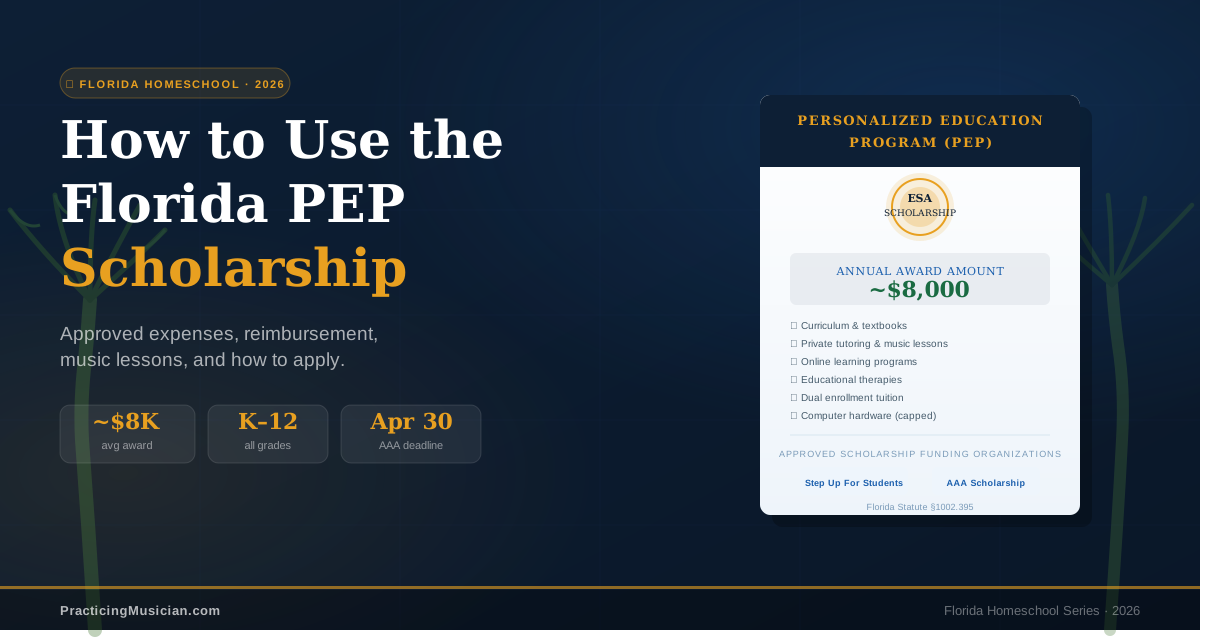
The PEP Scholarship is at capacity for new students for the 2026–27 school year through Step Up for Students. Renewal students are not affected. New applicants should apply through AAA Scholarship Foundation, which has confirmed available capacity. AAA application deadline: April 30, 2026.
PEP students operate under Florida Statute §1002.395, not §1002.41. PEP families do not file a Notice of Intent with their county, do not submit portfolios or evaluations to the county, and are accountable to their Scholarship Funding Organization (SFO) instead. PEP students have three annual requirements:
- Submit a Student Learning Plan (SLP) to their SFO — a customized plan developed by the parent to guide instruction and identify needed goods and services
- Take an annual norm-referenced standardized test and submit results to their SFO
- Sign a sworn compliance statement with their SFO
That said, many PEP families still maintain a portfolio for their own purposes:
- College applications — admissions offices often want to see course descriptions and sample work
- Bright Futures scholarship documentation
- Personal records of their child's educational journey
- Preparing for the annual standardized test — a portfolio helps identify gaps
If you're unsure whether you're registered under the Home Education Statute or PEP, check with your SFO (Step Up for Students or AAA Scholarship Foundation) or your county's home education liaison. Need help understanding the PEP scholarship? Our Florida Homeschool Guide 2025–26 covers PEP amounts by county, how to apply, and the AAA capacity situation for 2026–27.
FAQ — questions parents ask most
What must a Florida homeschool portfolio include?▼
Under Florida Statute §1002.41, two things: (1) a log of educational activities made contemporaneously with instruction, designating by title any reading materials used, and (2) samples of any writings, worksheets, workbooks, or creative materials used or developed by the student. The parent determines what goes in the portfolio — there is no required format or subject list.
How long do I have to keep the portfolio?▼
Florida law requires you to preserve the portfolio for two years. The conservative approach — recommended by most Florida homeschool legal experts — is to keep it for two years from the end of the school year it documents. So your 2025–26 portfolio should be kept until at least June 2028.
Can the school district inspect my portfolio?▼
Yes, but only upon 15 days written notice from the district superintendent. The superintendent is not required to inspect portfolios — most never do. If you receive a written inspection request, you must make the portfolio available within 15 days. Keep your portfolio organized and you'll have nothing to worry about.
Do I need to keep attendance records?▼
No. Florida home education law does not require attendance records, a minimum number of school days, or a minimum number of instructional hours per day. The only requirements are the activity log and work samples. This is one of the most misunderstood aspects of Florida homeschool law.
What do Florida homeschool evaluators look for?▼
Evaluators look for evidence that the child made educational progress at a level commensurate with their ability. They want: a consistent activity log with dated entries throughout the year, work samples showing growth over time, reading materials listed by title in the log, and reasonable coverage across subjects. They are not grading your child or comparing them to public school standards. They are confirming that learning took place.
Can I use a digital portfolio instead of a paper one?▼
Yes. Florida law does not require a paper portfolio. A digital portfolio — Google Drive folders, a shared PDF, or any organized digital format — is perfectly acceptable. If you have an in-person evaluator review, you can either bring a printed version or show the digital version on a device. Many families use a hybrid: digital storage with a printed summary for the annual review.
Does online learning (like Practicing Musician) count toward the portfolio?▼
Absolutely. Online platform lessons count fully as educational activities. Log each session in your activity log with the platform name and lesson details, and save screenshots of completed lessons as work samples. Platforms with structured, sequential lesson paths — like Practicing Musician — are particularly easy to document because the progression is built in.
Does a PEP scholarship student need a portfolio?▼
PEP students are not required to submit portfolios or annual evaluations to their county school district. PEP accountability runs through your Scholarship Funding Organization (SFO) and requires three annual obligations: (1) a Student Learning Plan (SLP), (2) an annual norm-referenced standardized test, and (3) a sworn compliance statement. However, many PEP families still maintain a portfolio for college applications, Bright Futures documentation, and personal records. Note: PEP is at capacity for new students for 2026–27 through Step Up for Students — new families should apply through AAA Scholarship Foundation before April 30, 2026.
Start building your portfolio documentation today
Practicing Musician gives Florida homeschool families free, structured music lessons with sequential progression built in — exactly what makes music the easiest subject to document in your portfolio.
Get Started Free — It's Free →Free forever · 3,500+ lessons · 15 instruments · K–adult · No credit card required
This post covers portfolio requirements specifically. For the complete guide to Florida homeschool laws, PEP scholarship funding by county, associations, co-ops, and getting started — visit our Florida Homeschool Guide 2025–26.
Key resources referenced in this guide
- Florida Homeschool Guide 2025–26 — Complete guide to FL laws, PEP scholarship, associations, and co-ops
- Florida Homeschool Fine Arts Credit Guide — Earning fine arts credit through free online music lessons
- Get Started Free — PracticingMusician.com — 3,500+ free lessons, 15 instruments, K–adult
- Private Lessons — PracticingMusician.com — $90/month, 4 live sessions with expert teachers (PEP-eligible)
- Florida Statute §1002.41 — The Home Education statute text
- FLDOE Home Education Program — Official state guidance and district liaisons
- FPEA — Florida Homeschool Requirements — Practical guidance from Florida's largest homeschool association
- HSLDA Florida — Legal guidance and sample evaluation forms
- FPEA Support Group Directory — Find certified teacher evaluators and co-ops near you


Leave A Comment
You must be logged in to post a comment.