
Don't just practice skills. Learn to play like a musician.
Whether you're learning for yourself, supporting a young player, or guiding a classroom full of them, Practicing Musician is built around one idea: new skills stick when the method is grounded in the science of how the brain actually learns. Confidence grows naturally when learners can see and feel their own progress.
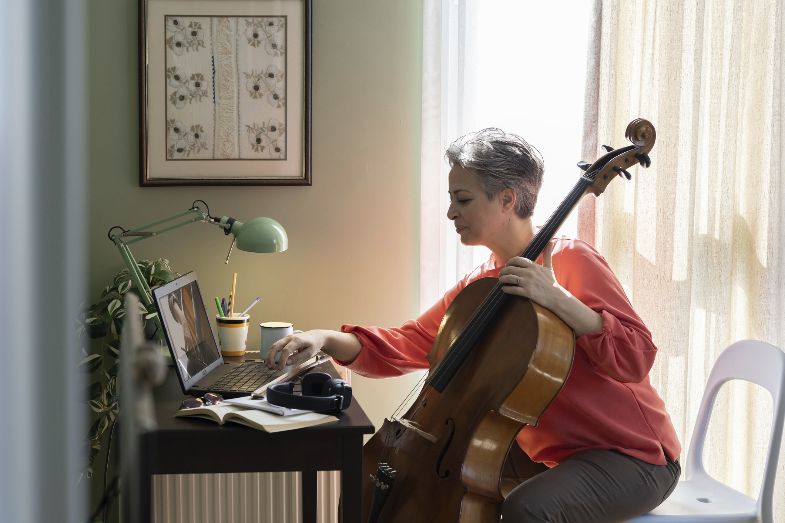
One concept at a time. Every time.
Research on how the brain processes new information shows that trying to learn too much at once actually prevents learning. That's why every Practicing Musician lesson is designed around a single skill or concept, practiced, reinforced, and built on gradually. Students at every age and stage build real, lasting musical ability.
One skill per lesson
Each micro-lesson has a clear, focused goal so students always know what they're working on and why.
Built-in review
Skills are revisited across lessons in new ways, the same way athletes train: layered, spaced, and intentional.
Memory that lasts
Content is taught through video, notation, listening, and feedback together, forming stronger memory traces.
Constant feedback
Students set goals, take action, and receive guidance at every step, not just at the end of a song.
This isn't just theoretical. Years of practice prove it works.
The Practicing Musician curriculum is built on findings from neuroscience and educational research. Here's what that actually looks like in practice.
& Retrieval
Learning that stays, not just learning that sticks for a test.
Lessons are structured so students revisit material over time, in the same way elite athletes train. Returning to a concept days or weeks later, in a new context, is what moves it from short-term to long-term memory.
Learning in layers.
Rather than repeating the same thing until it's "done," skills are retaught across different musical pieces and situations. This builds a web of connected musical understanding that stays with learners long-term.
Understanding the "how" and the "why."
Every video lesson includes guided questions that ask students to think about what they're doing, not just copy it. When students can explain what they're learning, they own it.
Learning through multiple channels at once.
Lessons combine video modeling, printed notation, verbal instruction, and listening exercises, because engaging more than one sense at a time creates stronger, more durable memory.
The goal isn't to practice for a lesson. It's to walk away with musical ability you'll enjoy for a lifetime.The Practicing Musician Method
Progress you can feel. Results you can hear.
Most music programs measure success by songs completed. We measure it differently: by whether students are genuinely developing musical thinking, refining their ear, and building confidence that shows up every time they pick up their instrument.
Musical thinking
Students learn to understand music, not just repeat it. They develop the ability to listen critically, read notation, and make intentional choices as they play.
A sharper ear
Listening exercises are woven into every lesson, training students to hear what they're playing and adjust in real time, a skill that sets great musicians apart.
Confidence that grows
Because progress is visible and incremental, students always know where they stand and what they're working toward next. That clarity builds real confidence.
Read the full research.
The complete academic paper by Dr. Frederick Burrack includes detailed descriptions of every learning theory, citations, and the full neurological research behind the Practicing Musician curriculum.
Read the full research →Become a practicing musician.
Start free today and experience the method as a self-guided learner, or enroll in private lessons with an expert musician ready to meet you where you are.
Enroll now